DocChat: Intelligent Document Retrieval & Verification for Technical Data

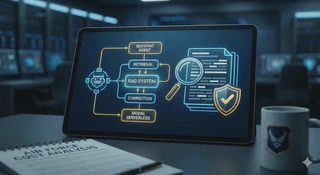
A high-precision RAG system designed to bridge the “Hallucination Gap” in technical document audit.











🎖️ The Inspiration: From Defense Analysis to Data Science
During my time as a Cost Analyst for the U.S. Air Force, I navigated the “Document Maze”—thousands of hours spent auditing dense technical proposals, program descriptions, and complex contract policy manuals. In high-stakes defense environments, missing a single footnote in a 500-page document isn’t just an inconvenience; it can lead to multi-million dollar discrepancies.
I built DocChat because I knew there was a better way to ensure 100% accuracy without the human burnout. This tool moves beyond simple “Chat-with-PDF” wrappers to create a system that thinks like an analyst: verifying its own claims and handling complex layouts that traditional AI often fails to parse.
🚀 The Industry Problem: Why I Built This
Generic AI often fails in specialized sectors like Defense, Finance, or Law because it lacks rigor. I built DocChat because I knew there was a better way to ensure 100% accuracy without the human burnout. I moved beyond a simple “Chat-with-PDF” wrapper to create a system that thinks like an analyst:
- Trust, but Verify: Just as an analyst cross-references sources, DocChats’ Verification Agent checks every AI claim against the original source text.
- Context is King: Using Docling, I ensured the AI understands table structures and complex layouts—elements where standard RAG systems usually break.
- The “Full-Stack” Advantage: By deploying this on Modal with a Dual-LLM (Gemini/OpenAI) failover, I’ve demonstrated the ability to take a high-level business need and turn it into a resilient, scalable, and cost-effective cloud application.
🏗️ Architecture & Engineering
This project is a full-stack engineering demonstration of how to build and deploy a heavy RAG pipeline on serverless infrastructure.
The Multi-Agent Orchestration
Instead of a linear prompt, the app utilizes a LangGraph-driven state machine that mimics a human research workflow:
- The Research Agent: Conducts a Hybrid Search (BM25 + Vector) to find relevant data.
- The Verification Agent: Cross-checks every generated claim against the original source text to eliminate hallucinations.
- The Self-Correction Loop: Automatically triggers a re-run of the research phase if unsupported statements are detected.
Technical Infrastructure
- Serverless Intelligence: Deployed on Modal, utilizing Infrastructure-as-Code (IaC) to manage GPU resources and custom container environments.
- Layout-Aware Parsing: Implemented IBM Docling to treat PDFs as visual structures, ensuring the AI understands multi-column tables and headers that standard parsers merge into “text soup.”
- Reliability Engineering: Developed a Dual-LLM Failover strategy using Gemini 2.5 Flash as the primary engine and GPT-4o-mini as an automatic fallback.
🛠️ Tech Stack
- Orchestration: LangGraph
- LLMs: Gemini 2.5 Flash, OpenAI GPT-4o-mini
- Data Engineering: IBM Docling, RapidOCR, ChromaDB
- Infrastructure: Modal (Serverless Cloud), Python 3.12, Gradio (UI)
